Top Signs You Need Garage Door Service – Don’t Ignore These
Most garage door failures send warning signals for weeks before anything actually breaks. A door that’s about to snap a spring doesn’t go silent – it gets louder. The grinding or popping sound most homeowners assume is “just how old doors sound” is usually metal fatigue announcing itself. Below, the sounds, movements, and delays worth paying attention to, what each one means, and the point at which a Kamm’s Corners homeowner should stop tolerating the quirk and book a repair. If you’d rather not DIY the diagnosis, call (888) 839-8159.
Which Noises Are Normal and Which Mean Act Now?
Some garage door noise is just cost of ownership – a door that’s been opening and closing twice a day for years will make a little racket. The skill is separating the harmless from the urgent. Here’s how we sort them in our experience.
Annoying but stable – fixable, not an emergency:
- Rattling or banging that gets better after a quick visual check for loose hinges, brackets, or roller shafts.
- A steady squeak that tracks with the door’s movement, usually a dry roller or hinge pivot.
- Enough noise that you can hear the door from the kitchen, but it rises and falls smoothly with the door’s travel.
Act now – stop using the door and call:
- A sharp pop or snap followed by the door going heavy and only opening a foot before reversing. That’s a torsion spring breaking.
- A twang, metallic ping, or sudden change in pitch on one side – a sign the spring coils have separated.
- Fraying at the cable drum or near the bottom corners. A damaged cable under tension can whip, and that’s a genuine safety risk.
- Continuous grinding from the opener head rather than the door – that’s the machine, not the door, and it usually needs a technician.
If you hear a pop in Kamm’s Corners and the door won’t lift, don’t stand under it or try to force it. Call us and we’ll dispatch a technician. Springs and cables are under extreme tension and are not a safe DIY repair.
Why Does My Door Open Unevenly or Tilt to One Side?
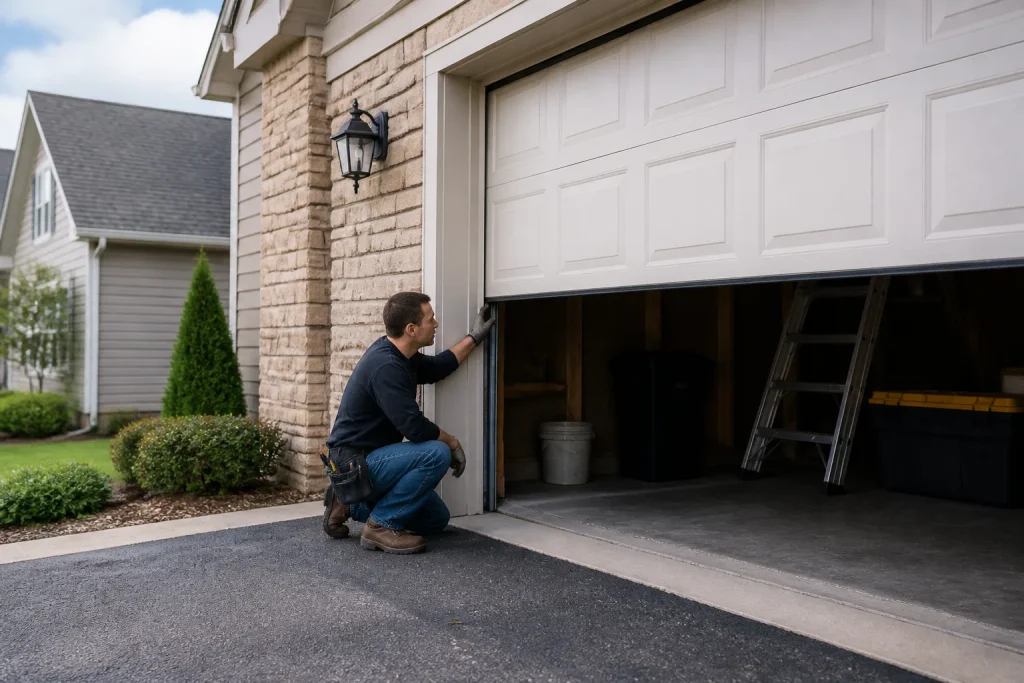
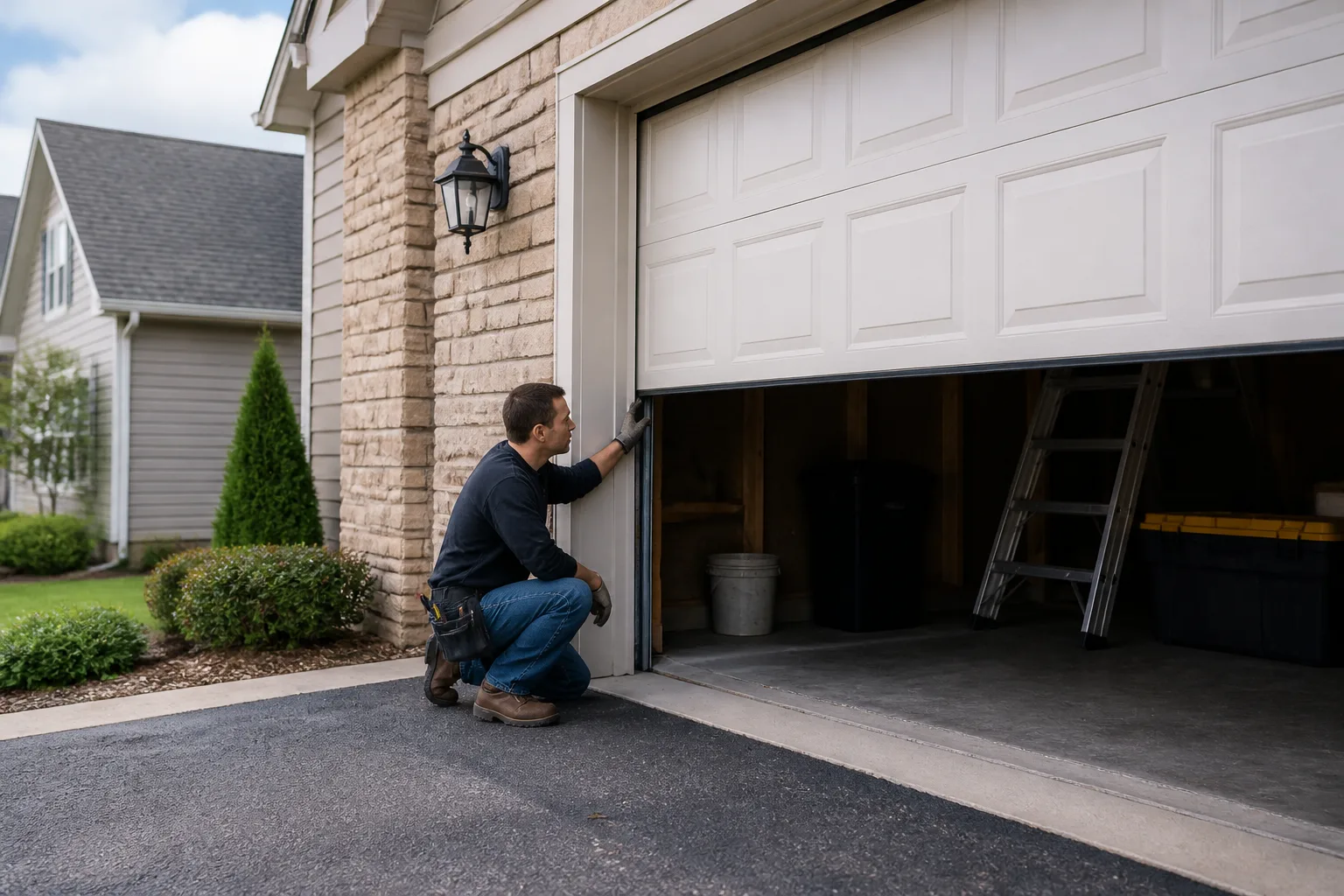
A door that lifts crooked – one side dragging, one side higher, the panel visibly tilted – is almost never a track alignment problem. In our experience it’s the cable or spring on one side losing its grip. The door is being carried by one good spring and one dying one, or a cable has stretched enough to throw the tension off. Homeowners often assume the track needs straightening; sometimes it does, but usually the track is fine and the load isn’t being shared evenly.
That matters because an unbalanced door doesn’t fail gently. The weak side loads harder every cycle, and when it finally goes, it goes suddenly – sometimes mid-lift with a car underneath. A door that visibly tilts is telling you the balance has already shifted. A door that tilts and reverses partway up is further along.
We check springs, cables, drums, and rollers together rather than adjusting one part and leaving the rest. Garage door repair is what we do all day, and an uneven door is one of the most common things we’re called out for.
What Is the Manual Lift Test and How Do I Do It?
It takes 10 seconds and tells you whether your springs are still carrying their share of the door’s weight. Here’s how, with the door closed:
- Pull the emergency release cord (the red handle) to disconnect the opener from the door.
- Lift the door by hand, halfway, slowly. Use the bottom handle, not the panels.
- Let go at the halfway point.
A door with healthy springs will hold roughly where you let it go. A door that sags or drops toward the floor is a sign the springs have lost tension. A door that has to be hauled up with effort means they’re already working against you.
Two cautions. Never do this test if the door is already crooked, jammed, or visibly missing a roller. And never try to adjust springs yourself – torsion and extension springs are under high tension, and a slip can cause serious injury. If the door doesn’t hold, reconnect the opener later only after a technician has looked at it. In our experience, a failed manual lift test is the clearest single signal that garage door opener repair alone won’t fix the problem.
Why Does My Opener Hesitate Before the Door Moves?
That half-second delay between pressing the remote and the door actually moving is one of the easiest signals to dismiss – and one of the more useful ones. A healthy opener starts within a fraction of a second. When it starts to lag, it’s usually a dying capacitor or a worn drive gear, not a remote battery problem. The opener is still working, but it’s working harder, and that’s the stage where a repair is quick and inexpensive versus a full opener replacement.
Other opener-level signals worth a look:
- The light flashes or the wall button does nothing for a moment, then catches up.
- The door reverses for no obvious reason.
- The opener motor runs but the door doesn’t move (a stripped gear).
- Smart or Wi-Fi features that drop out intermittently – often the same capacitor beginning to fail.
We work on the brand you already have, whether it’s a newer Genie, a Wayne Dalton like many Kamm’s Corners homes have, or a Clopay that came with the house. Diagnostic checks like these are why we treat opener service as its own dedicated job, not a tack-on to a door repair.
When Should You Call a Pro?
The line is simpler than most homeowners expect. Call a technician if:
- The door won’t hold on the manual lift test – that’s a spring issue, and springs need a trained hand.
- You hear a pop, snap, or sudden change in pitch from the springs or cables.
- The door tilts, drags, or reverses partway up.
- The opener grinds, hesitates, or runs without moving the door.
- Your safety sensors trip repeatedly, or the auto-reverse fails to work when you test it with a small object.
Every one of those is repairable. Ignoring them is what turns a $200 repair into a whole-door replacement, or, worse, a door that drops on a car or a foot. Our technicians have up to 11 years of experience with exactly these symptoms, and we quote the job in writing before any work starts. If you’re unsure whether a sound or a tilt is worth a call, call anyway – we can talk you through it over the phone.
Related services in Kamm’s Corners – spring repair, opener service, panel and roller replacement, and full new-door work, all under one roof. When a repair turns into a replacement, you won’t need to find a second company. If you’re weighing a full rebuild, see our garage door installation page.
Why Do Warning Signs Get Worse in a Kamm’s Corners Winter?
Cold accelerates every one of these symptoms. Metal contracts, grease thickens, and the springs and rollers that were already at their limit become the first to complain. Around Kamm’s Corners, a door that ran quietly in September often develops a groan by December – and a door that was already making noise will get louder, or fail outright. That seasonal pattern isn’t random. It’s the same wear, just pushed harder by weather.
Here’s the pattern we recognize:
- Grinding or groaning in winter that smooths out in warm weather usually means thickened lubricant or a worn roller, not a spring that’s healed itself. The wear is still there; you’re just not hearing it.
- Stiff manual lift that eases in spring can still signal tired springs. Cold makes them stiffer, and the difference between “cold stiff” and “worn” is subtle.
- Opener hesitation that appears only on cold mornings is a classic capacitor symptom. The part is degrading and the cold is exposing it.
- Ice or snow packed against the bottom seal that makes the door drag – dragging stresses the opener and the cables, so clear it rather than letting the opener fight it.
If a symptom disappears with the season, don’t assume it’s gone. It’s telling you what’s worn and giving you the whole warm season to fix it before the cold comes back. For a Kamm’s Corners homeowner, the honest rule is: winter signs are a to-do list for spring, not a free pass.
The Bottom Line
Those small noises, hesitations, and tilts aren’t quirks to live with – they’re a countdown. Loud and stable means check it; sharp pops, uneven lifting, and a failed lift test mean stop using the door and call. The earlier you act, the cheaper and simpler the fix. In our experience, the doors that break at the worst possible moment are always the ones that were warning someone for weeks.
If you’re in Kamm’s Corners and need help, Garage Door Repair Kamm’s Corners offers free estimates – call (888) 839-8159. We quote before we touch the door, and every repair comes with a written price you agree to first. Repair, opener service, spring work, or a full new door: Garage Door Repair Kamm’s Corners covers the whole job, so your door is done right.
Frequently Asked Questions
Noise that changes character – a new pop, snap, or grinding that wasn’t there before. A door that used to run quietly and now doesn’t is the earliest and clearest signal. Take it seriously: the sound usually starts small and gets louder. Call (888) 839-8159 for a free estimate if you’re unsure whether it’s worth a look.
You can do the manual lift test from outside the door with the opener released – lift halfway and see if the door holds. You should never adjust, remove, or replace the springs themselves. Those are under extreme tension and require a trained technician. If the door sags or won’t hold, call (888) 839-8159 and stop using the opener.
It’s not an emergency yet, but it should be fixed before the door cycles many more times. A tilt usually means a cable or spring is losing tension on one side, and that failure can become sudden. Call us for a same-day assessment – (888) 839-8159. Estimates are free.
Yes – cold tightens metal and thickens grease, so existing wear becomes more obvious. Symptoms that appear only in winter are still real wear, not a seasonal fluke. Have them checked before the cold returns. We serve Kamm’s Corners homeowners – call (888) 839-8159 for a free estimate.
Written by the team at Garage Door Repair Kamm’s Corners.
Need Garage Door Help?
Call Garage Door Repair Kamm's Corners - the local pro we connect you with is licensed and insured, here with fast after-hours help in Kamm's Corners.
(888) 839-8159